Rides
Every ride gives something back
Briefed, disciplined, and open to every rider — beginners included. Here is how a ROAR ride runs, and what you take home from it.
2026
- Ride
- Long weekend ride — Delhi to Mukteshwar
- When
- Departs Thursday night, 1 October; in Mukteshwar 2–4 October 2026; back late Sunday night
- Where
- Mukteshwar, Nainital district, Uttarakhand (7,500 ft) — Bhalugarh Waterfall, Mukteshwar Dham Temple, Chauli ki Jaali and Zero Point
- Format
- Overnight ride out, two nights in the hills, easy pace with real time at each stop. A proper long-weekend trip with the group
- Stay & meals
- 2 nights' accommodation, 2 breakfasts, 2 lunches, 2 dinners — split at cost across the group, roughly ₹3,096 per person. Fuel, personal spends and en-route snacks are on you
- Cost
- Ride is free to join; you only split the actual cost of the stay and meals with the group — nothing added on top
Seats are limited — rooms are booked as a group, so let us know early.
Next ride
Ride into the wild — Mukteshwar, 2–4 October
A long weekend in the hills of Nainital district — a waterfall, a hilltop temple, a natural rock arch and a Himalayan viewpoint, with two easy nights to actually unwind. To join, fill the form further down this page, message us on WhatsApp, or use the contact page.
Meetup rides are on the meetup page. The next one is Saturday 17 October, evening. Ride SOS sheet · spare-seat board.
Why ride with us
A group, not a guided tour
Most motorcycle outfits sell you a seat, run the itinerary, and drop you home. Roar Riders works the other way round. You are not a passenger here — you are part of a group that looks after its own on the road and leaves every place it rides through better than it found it.
That means real structure. A lead rider setting a pace the whole group can hold. A sweep rider at the back so nobody is ever left behind, carrying tools and a first-aid kit. Turns marked rider to rider, fuel stops planned around the shortest tank, hand signals moving down the line so a convoy of twenty reacts to a pothole or a stray dog as one machine.
And it means a reason to be there beyond the ride itself. Before we turn for home we stop and do the work — plastic cleared off a slope, water set out for strays, an injured animal driven to a vet, another instalment into the education fund. That is what Roaring for Nature looks like in practice, and it is the direction the whole group is headed: more riders, more routes, more done for the places we love to ride.
What you actually need
- A road-legal motorcycle in good running order
- A certified helmet — every ride, no exceptions
- Riding gloves; a jacket if you own one
- A valid licence and your bike's papers
- The willingness to ride by the group's rules
Turn up with these and you ride. The badge on the tank does not matter — the rider does.
Who this is for
Every kind of rider
Built to work for the rider who bought their first bike last month and the one who has crossed the country twice.
New riders
Your first year is the steep one. Ride with people who brief every route, mark every turn and never leave you behind — and pick up good habits by watching riders who already have them. Nobody here will make you feel slow.
Solo riders
Riding alone is freedom — right up to a breakdown on an empty road at dusk, or a fall with nobody around. With ROAR you keep the freedom and drop the risk: a group that notices the moment you fall back, and turns around.
Experienced riders
You have done the miles. What is often missing is a reason. ROAR rides are disciplined enough to actually enjoy and purposeful enough to matter — and lead, sweep and marshal roles need riders with exactly your judgement.
Women riders
Group riding is one of the safest ways to ride, and it is meant for everyone. Women ride, lead and marshal at ROAR — not as a separate category, just as riders. Start with a public meetup ride, meet the group in the evening, and decide for yourself. More on this below.
Returning riders
Back on a bike after years off? The instinct is still there; the sharpness takes a few rides. Ride with a group that eases you back in — shorter routes first, no ego, and marshals who remember what rust feels like.
Pillion & two-up riders
Riding two-up changes braking, cornering and gaps. ROAR briefs for it, places you where the convoy has room, and never pressures a two-up rider to hold a solo pace. Partners and friends on the back are part of the group.
Women riders
Riding is for everyone
Riding is for everyone, and so is this community. If you have put off long routes or unfamiliar roads because riding solo as a woman does not always feel safe, a group ride is exactly the fix. On a ROAR ride you are inside a briefed convoy with a lead and a sweep, contact numbers shared before roll-out, fuel and rest stops planned, and a group that will not move off without you.
Women ride with ROAR as full members and take on lead, sweep, marshal and organising roles. Your first contact with the group is never a stranger on an empty highway — it is an evening meetup ride, with everyone present. Come and see how it feels, ask anything you want, and bring a friend if that is easier.
A comfortable first step
The 17 October meetup ride is a public, evening meet. Come, chat, ask questions, ride an easy loop, and leave. That is the whole commitment.
How a ROAR ride works
Five things, every ride
-
Gear check and briefing
Helmets and basic gear are checked before anyone starts an engine — no helmet, no ride, and you are welcome to follow in a support car instead. Then we run the route, pace, fuel stops, hazards and hand signals. Beginners get the extra few minutes they need.
-
Lead and sweep
The lead rider holds a steady, legal pace at the front. The sweep rider rides last, keeps the tail together and carries the kit. Everyone in between rides in staggered formation with real gaps — room to brake, room to move.
-
Ride your own ride
No racing, no overtaking the lead, no pressure to ride faster than you are comfortable with. The group bends to the pace of its slowest safe rider, and turns are always marked so nobody has to guess or hurry.
-
The service stop
The nature action planned for that route — a clean-up, a wildlife or stray-animal task, or an education drop. Everyone takes part; it is written into the ride, not tacked on at the end for whoever feels like it.
-
Regroup, debrief, certificate
We regroup, count everyone in, and talk briefly about what went well and what to fix next time. Every rider who completed the ride is handed a printed ROAR certificate before heading home.
What we run
Rides and events
We publish rides as they are planned. The next one on the calendar is the 17 October meetup ride — start there.
Meetup rides
Short, evening and easy-paced — the ideal first ride. Meet the group, take the nature pledge, and ride a relaxed loop back. Done by mid-evening.
Day rides
A full day out to a hill road, a lake or a forest route, with a proper service stop — a clean-up or an animal-welfare task — built into the plan rather than squeezed in.
Weekend rides
An overnight halt, real distance, and a bigger nature action: a full clean-up drive, a shelter visit, or an education drop in a village along the way.
Outstation rides
Planned multi-day trips to farther ground — several days away, a route recced in advance, and a proper service project at the destination. The certificate covers the whole run.
Education events
Not every meet is a long ride. Some are short runs to a school with the books and kits our ride fund paid for, plus sessions where riders talk to children about road sense and looking after the outdoors.
First-aid & safety sessions
Ground sessions, no engines: basic roadside first aid, what to do when a rider goes down, how to pack a kit, and how to read a mountain road. Open to members and to anyone thinking of joining.
Something to show for it
The ROAR ride certificate
Every rider who completes a ROAR ride and takes part in the service stop is handed a physical Certificate of Distinguished Participation at the end of the day — printed, in the rider's name, given out on the ride itself rather than emailed weeks later or buried on a page somewhere.
It is a small thing, but it matters. Being part of this group is not just a nice weekend out; it is a genuine accomplishment — kilometres ridden well, in formation, and a real piece of work done for nature at the other end. The certificate is the proof of that, and it is yours to keep.
- Printed and handed over on the ride, in the rider's name
- Names the ride, the date and the nature action you were part of
- Logged in a simple ride record so the community keeps its history
- A scannable verification code is planned for a later phase
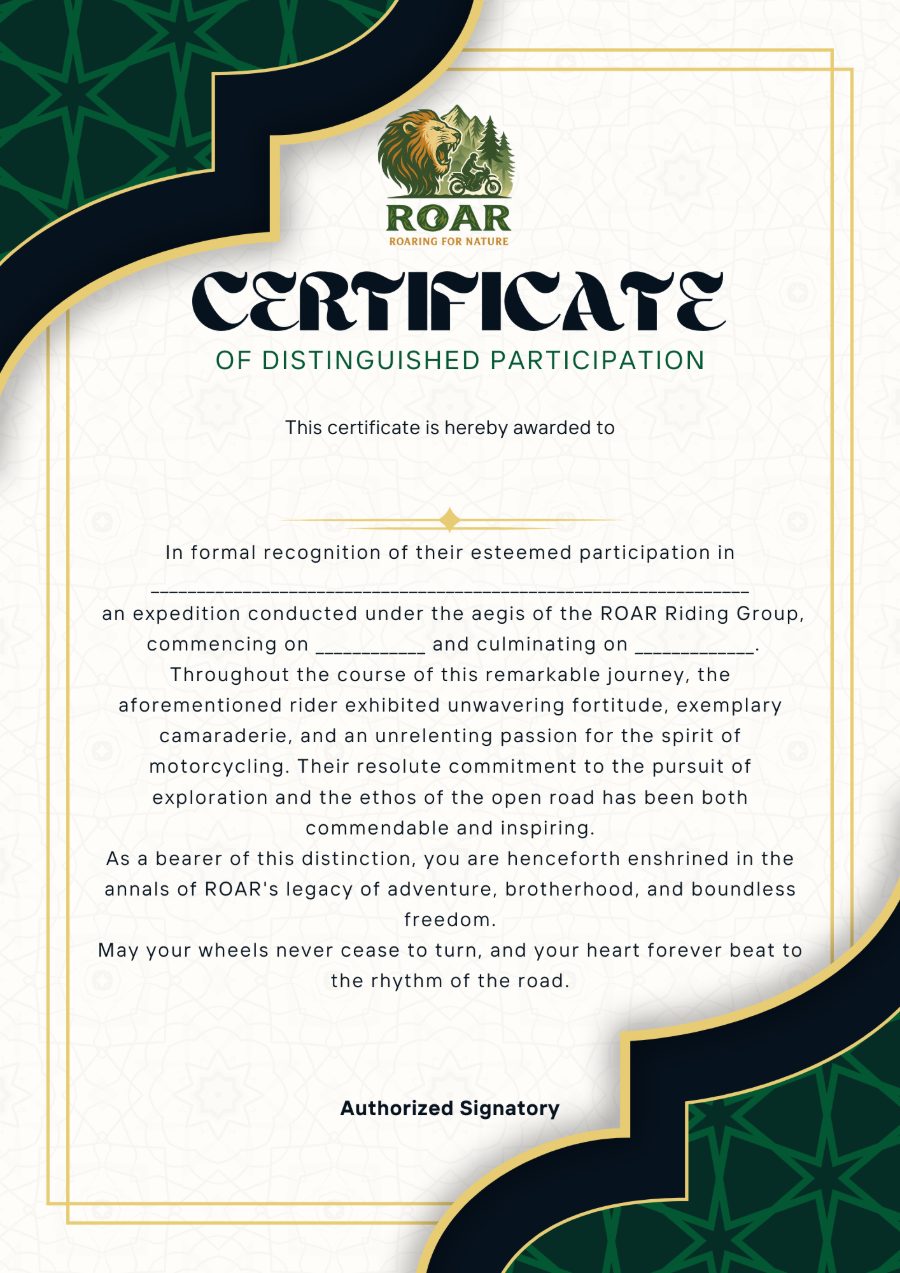
Sample artwork. Rider name, ride and dates are filled in for each participant.
Common questions
Before you ride with us
Do I need an expensive motorcycle to join?
No. Any road-legal motorcycle in good running order is welcome — commuter, retro, adventure or tourer. What matters is the rider and the gear, not the machine.
Is it beginner-friendly?
Yes — beginners are expected. Every ride opens with a full briefing, a lead rider sets a sane pace and a sweep rider makes sure nobody is left behind. Start with a meetup ride.
Is it safe for women riders?
Group riding is one of the safest ways to ride. Women ride, lead and marshal at ROAR as full members. Your first contact is a public evening meetup ride, with the whole group present.
Does it cost anything to ride with ROAR?
Rides are free to join. You cover your own fuel and food. A share of what is collected on service rides goes to the education fund.
What is the ROAR ride certificate?
Every rider who completes a ROAR ride and takes part in the service stop is handed a printed Certificate of Distinguished Participation on the day.
What do I need to bring?
A certified helmet — no helmet, no ride. Riding gloves, a jacket if you own one, your licence and the bike's papers, a full tank, and a small bag for any litter we collect. The exact list for each ride goes out on WhatsApp beforehand.
What happens if my bike breaks down?
The sweep rider at the back carries tools and a first-aid kit and stays with you, and a technical lead helps with roadside fixes so a small fault doesn't end your day. If it can't be fixed on the road, we help you arrange recovery.
How fast do you ride, and how far?
A lead rider sets a steady, legal pace the whole group can hold — never a race. Meetup rides are short loops, evening pace; day rides run out to a hill road, lake or forest and back; weekend and outstation rides cover real distance with overnight halts.
How do I RSVP or join a ride?
Fill in the form on the ride's page, or message us on WhatsApp. Once you've RSVP'd we add you to that ride's WhatsApp group, where the roll-out point and reporting time are shared a few days before.
Do I have to take part in the clean-up?
Yes — it is the point of the ride, not an optional extra, and everyone who rolls out takes part. It usually takes 30 to 60 minutes and we bring the gloves and bags.
What if the weather turns bad?
The ride captain makes the go / no-go call on weather and road conditions and posts it to the WhatsApp group. A ride that can't run is rescheduled, not cancelled.
Do you do multi-day and outstation trips?
Yes. Alongside meetup and day rides we run weekend rides with an overnight halt, and planned outstation trips of several days — the route recced in advance and a proper service project at the destination. The certificate covers the whole run.
Ride enquiries
Want in on a ride?
Tell us a bit about you and your bike using the form below, or message us on WhatsApp for a quicker reply. For the 1–4 October Mukteshwar long weekend, mention it in the message.